
The guests arrive. The heater starts. The first 30 minutes begin.
An operator reviews the season's utility spreadsheet. Heating cost per unit-night: $4.20. Cooling: $3.80. Annual energy spend: within budget. The numbers say the site is efficient.
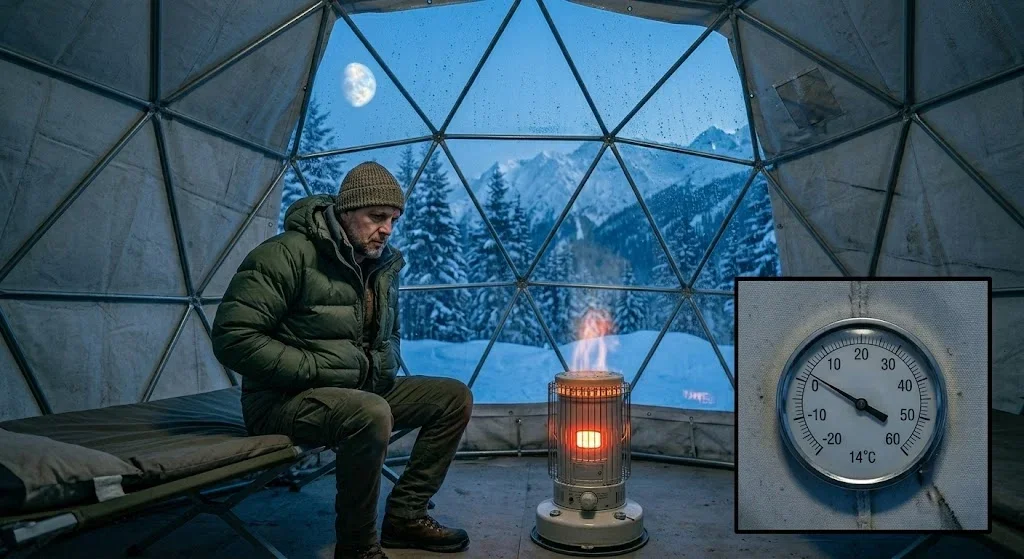
A guest walks into a hunting lodge in Montana at 4 PM on an October afternoon. The guide unlocked the door three hours ago and turned on the heater. The thermostat reads 14 degrees — not 21 — and the guest keeps their jacket on. Their review will mention the cold room, not the utility bill.
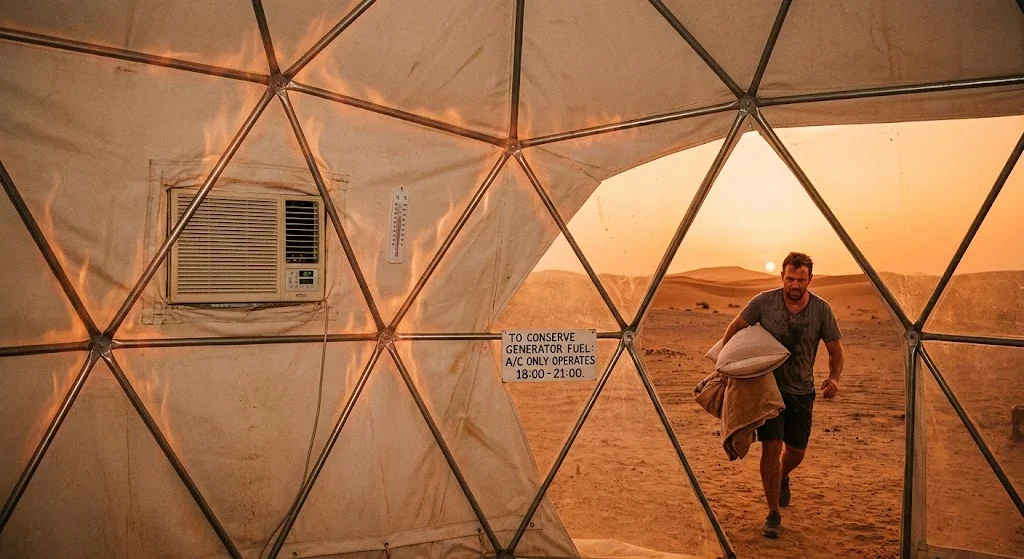
Arizona, July, 38 degrees. The host arrives two hours before check-in, starts the AC. Two hours later the room is 29 degrees — the walls let heat in faster than the unit can remove it. The guest's first 30 minutes are unconditioned.
Why the walls decide the first 30 minutes
A building loses heat at a rate set by its R-value. Lower R-value means faster heat loss. After the HVAC starts, the room warms only as fast as the heater can overcome what is leaking through the walls.
A PVC fabric membrane is R-1. The 106-millimeter MarsDome composite shell is R-28. That is a 28-to-1 difference. Per square meter, per degree of temperature difference, the fabric dome loses 28 times more heat.
Turn on a 5-kilowatt heater in each. The fabric dome's walls lose roughly 5 kilowatts while the heater adds 5 — net gain near zero. Three hours later, the room may still not be warm. In the MarsDome, the walls lose less than 200 watts and the air warms in minutes.
Cooling runs the same physics backward. On a 38-degree day, fabric walls admit so much outdoor heat that a 12,000-BTU air conditioner stalls at 29 degrees. It cannot go lower. The same AC in a MarsDome reaches 24 degrees and holds. The walls let in only 130 watts.
The passive house standard, developed in Germany in the 1990s, demonstrated this principle at full building scale. Make the envelope thick enough and a structure barely needs active heating — regardless of climate. The physics does not care about building shape. It cares about wall thickness.
The invisible cost of slow recovery
When thermal recovery takes hours, operators pay for it whether the line item appears in their spreadsheet or not.
Some send staff 6 to 8 hours early to pre-heat or pre-cool. That is a dawn shift, overtime, or a second turnaround crew — every turnover day, for every unit.
Some run HVAC 24 hours a day through the entire season. The heater or AC never stops, even when the room sits empty for days between bookings. The solar array and battery bank must support continuous full-load operation, not just occupancy hours. For a multi-unit site, the upfront equipment cost difference is $15,000 to $35,000.
Some set AC timers to manage generator fuel cost. In the Moroccan Sahara, luxury tent camps restrict AC to three hours: 6 PM to 9 PM. After 9 PM, thin walls release the cool air and guests sleep outside — the tent is hotter than the open desert. In Jordan's Wadi Rum, generators shut off from 10 AM to 4 PM, leaving interiors at 38 degrees.
Each workaround converts slow thermal recovery into labor cost, capital cost, or reputational damage. None appears on the energy spreadsheet. All of them land in the guest's first 30 minutes.
The room is ready before the site orientation is done
A MarsDome sits empty for two weeks in autumn. The guide arrives with the guests — not three hours before them. He opens the door, starts the heater, and walks the group through a 15-minute site orientation. By the time introductions finish, the room is at 21 degrees.
In summer, the same sequence. A MarsDome in the desert, closed for days, interior at 38 degrees. The host opens the door, starts the AC. Twenty minutes later the room is 24 degrees — the AC cooled the air and kept it there.
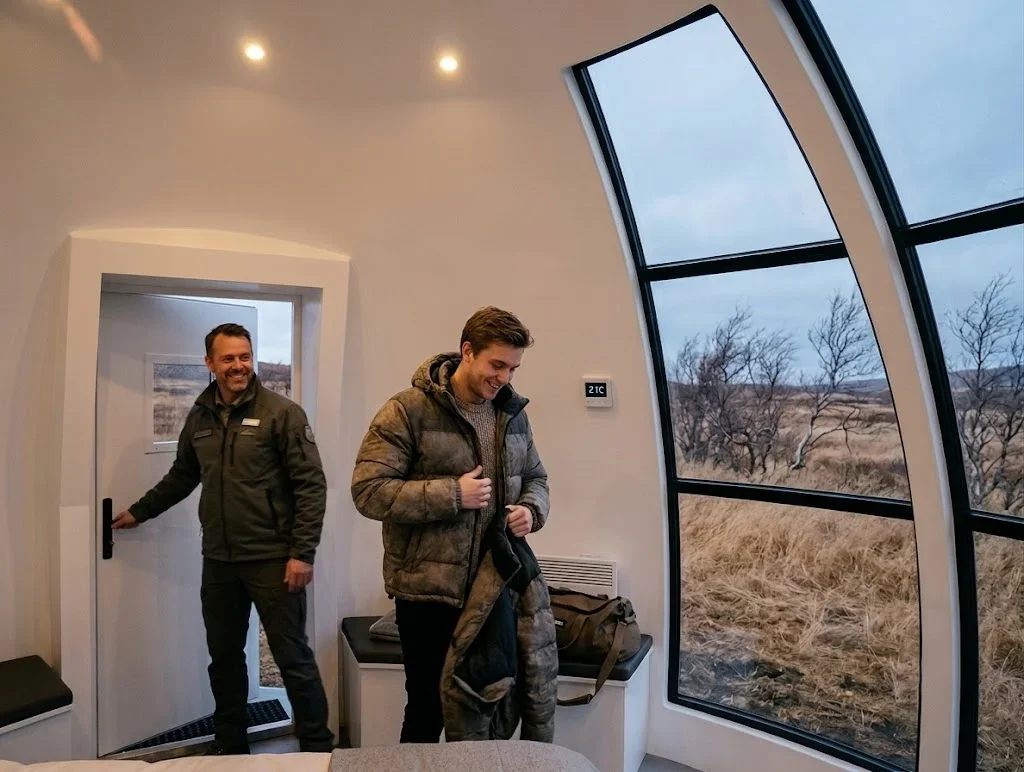
This removes an entire layer of operational planning. No pre-heating shift, no generator running through the night, no AC timer. The HVAC runs when people are present, not when the room is vacant. The solar array is sized for comfort, not for fighting the sun through a membrane.
The number is 35. That is the whole story. One wall keeps heat. The other lets it through.
The spreadsheet and the guest are describing different buildings
Annual energy data tells the operator what it cost to run the building. It says nothing about the first 30 minutes.
Those first 30 minutes are determined by thermal recovery time. How fast can the room go from outdoor temperature to 21 degrees? The answer shapes whether guests arrive to warmth or wait in jackets. It determines whether the solar array is sized for occupancy or for 24-hour operation. It decides whether staff arrive at dawn or with the guests.
The number that matters to a guest is not $4.20 per unit-night. It is zero minutes standing in a cold room waiting for the heater to catch up.
* The Maintenance Treadmill — What Fabric Dome Operators Spend Year After Year