
Hurricane Helene put entire campgrounds underwater in western North Carolina in September 2024. When the water receded, the geodesic domes were still standing. The operators who returned saw curved frames against the sky and thought they had been lucky. Then they opened the doors.
The timber platforms were soft. The insulation inside the floor cavities was saturated. The steel frames sat in silt. The PVC membranes — the skin meant to keep weather out — had either been torn open by debris or lifted at the base by rising water. The domes had not collapsed. But several of them would never take another booking.
The shape survived. The materials inside did not.
How Water Enters a Geodesic Dome
Two things happen when flood water reaches a geodesic dome. Neither requires the structure to collapse.
First, debris. Flood water carries tree trunks, construction wreckage, whatever stood upstream. A 50-kilogram log moving at 3 metres per second tears through PVC membrane on contact. The physics is identical to wind-driven debris — a 2 × 4 timber at hurricane speed penetrates a building the same way a tree branch at flood speed penetrates a membrane. The fluid is different. The fabric failure is the same. Once the membrane is open, water pours through. The steel frame corrodes. The insulation saturates. The timber platform rots.
Second, even without a direct hit, the membrane-to-platform junction fails on its own. It is an overlap, not a seal. The PVC membrane drapes over the frame and past the edge of the timber platform. Rain runs down the curve and drips off. Gravity holds the fabric in place. This works for rain falling down. It does not work for water rising up. Hydrostatic pressure from below lifts the fabric. The unsealed junction opens. Water enters through a gap that was never designed to close. When the water recedes, the membrane settles back and traps the moisture inside.
Debris tears the skin open. Rising water lifts the unsealed edge. Either way, water gets in. Either way, the materials inside — steel, timber, fiberglass insulation — are destroyed.
Flood water enters a geodesic dome through two paths. Debris impact tears the PVC membrane — a penetration failure driven by the same physics as wind-driven debris. Or rising water lifts the membrane at the platform edge — the junction is a gravity-dependent overlap, not a pressure seal. Both paths lead to the same outcome: steel frame corrosion, saturated insulation, rotted platform.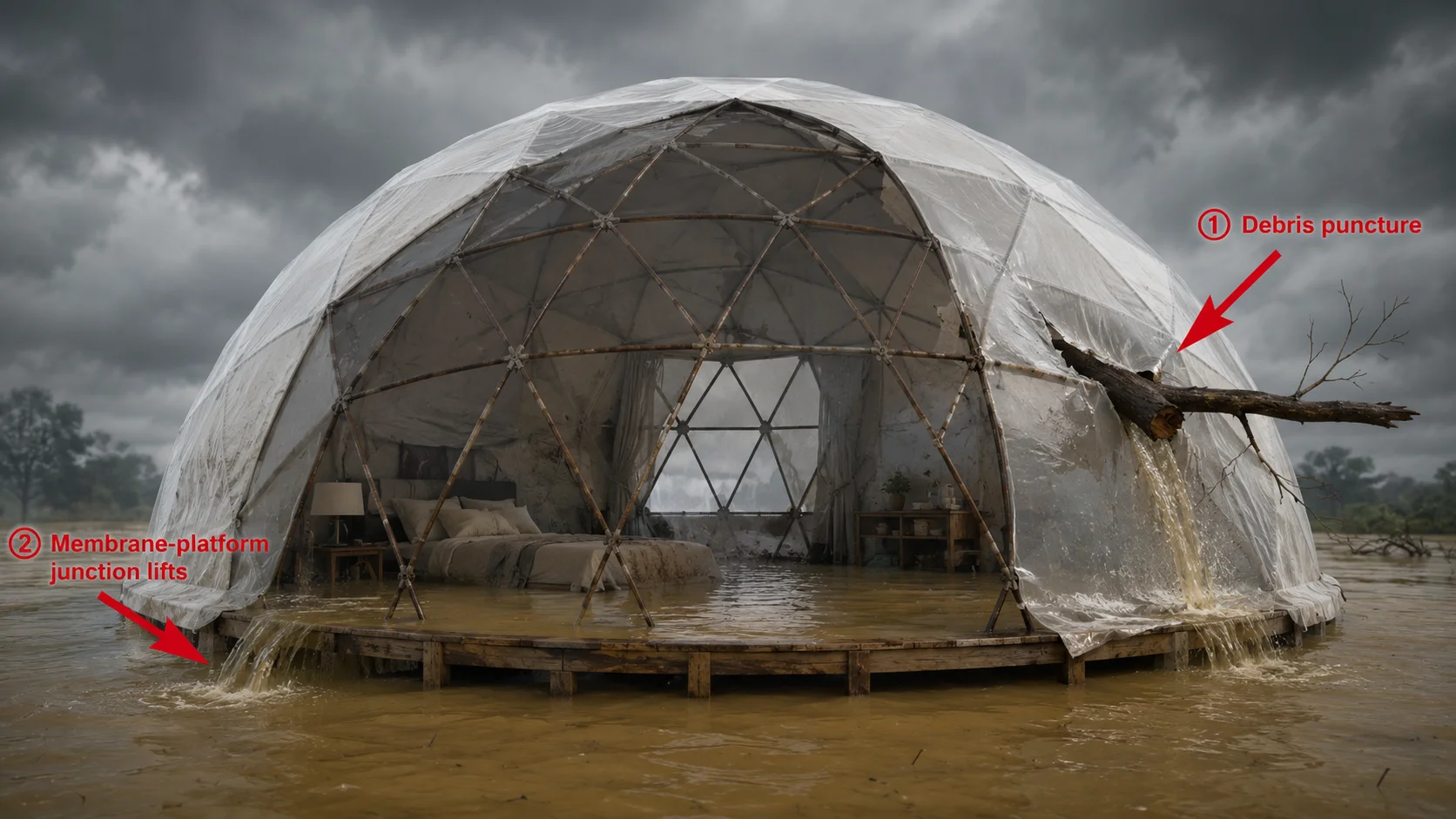
How Water Stays Outside a Composite Dome
A composite sandwich dome has the same curved shape. Same drag coefficient. Same wind-shedding geometry. Every dome shares these.
The difference is in the shell. The material is FRP — glass-fibre-reinforced polymer. The same chemistry used in yacht hulls, chosen because it absorbs less than 0.5% of its weight in water and does not rust, rot, or swell.
The thickness is what makes the chemistry matter. A PVC membrane is fabric — less than a millimetre between the inside of the dome and whatever the flood is carrying. Hit it with a log and the result is the same as hitting a tent fly: the fabric tears at the point of contact. There is nothing behind it to stop the impact.
A 106-millimetre composite shell is not fabric. It is a structural sandwich: two layers of FRP with a rigid polyurethane core between them. This is the same principle as a crash helmet — a hard outer shell to spread the force, a compressible core to absorb the energy, an inner shell that stays intact. The log hits the outer skin. The force spreads across the panel instead of concentrating at a point. The PU core crushes locally and dissipates the energy as heat and deformation. The inner skin holds. The log slides off. No puncture. No tear. No entry path.
A PVC membrane stops rain. It was never meant to stop anything heavier. A 4-inch composite shell stops what the flood carries because its thickness is not empty space — it is structure. The same 106 millimetres that carry the snow load and deliver R-28 insulation are the 106 millimetres that decide whether the shell opens or holds.
The shell is also a sealed vessel. The panels bolt together at flanged joints — a mechanical seal, not a gravity-dependent overlap. The doors have a three-layer waterproof design. The windows are waterproof. With everything closed, the shell is a continuous pressure-capable enclosure. Flood water rises around it. It does not enter. The interior stays dry.
A geodesic dome cannot do this. Its waterproofing works in one direction. Its membrane is a cover, not a seal. Its platform junction was designed to overlap — to let rain drip off, not to hold back rising water. Close the doors on a geodesic dome and water still enters from below.
A 4-inch composite shell stops debris that tears through PVC. The FRP outer skin distributes impact. The rigid PU core absorbs the energy. The same thickness provides R-28 insulation and carries the structural load. A PVC membrane is under a millimetre thick — no structural rigidity. A composite dome seals against water from any direction.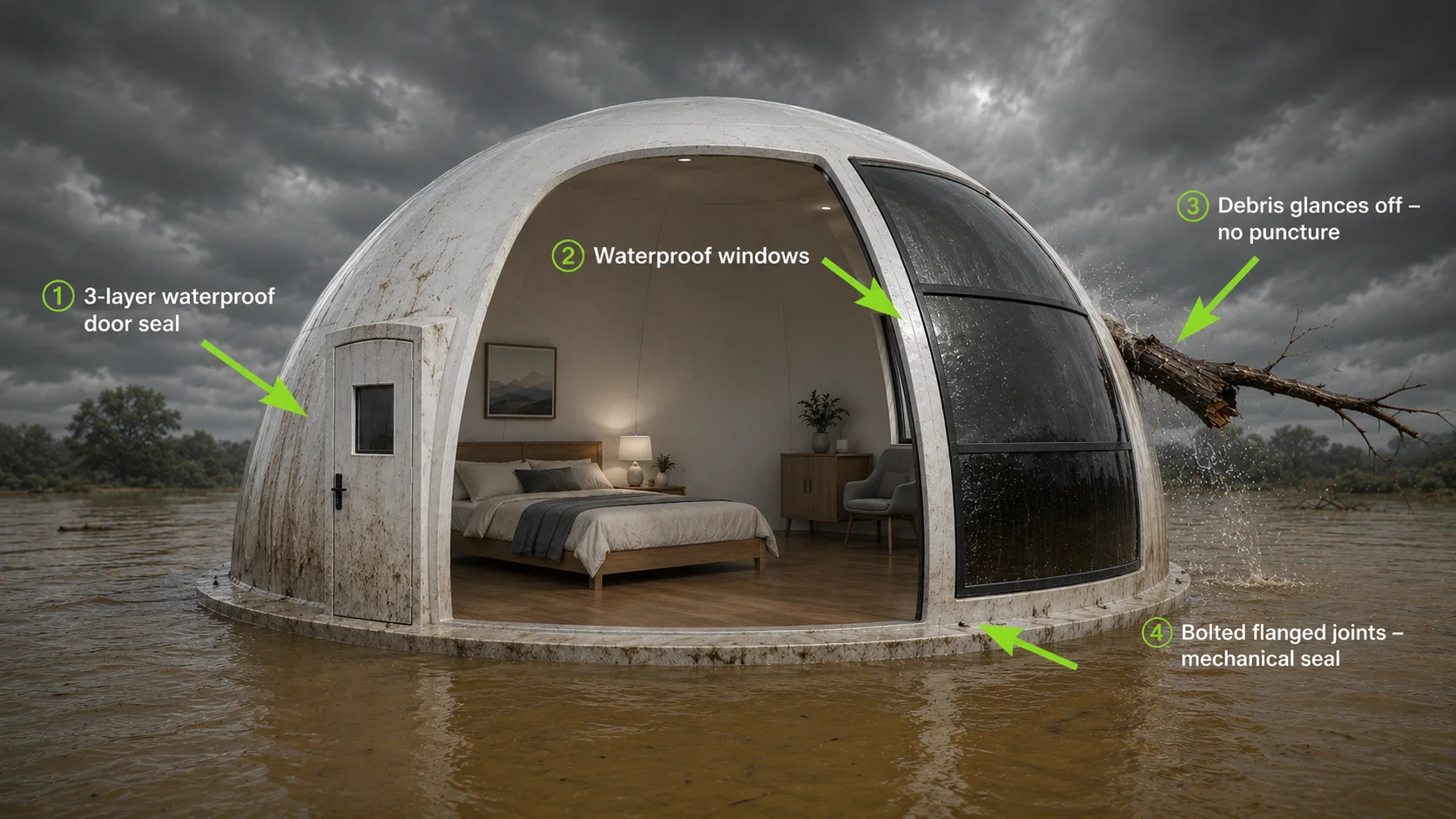
A geodesic dome is well-engineered for wind. Its curved shape cuts wind loads by roughly half. Its frame can be anchored to withstand storms that flatten conventional tents. These advantages are real. They are also shared by every dome geometry.
But a flood does not attack the frame. It attacks the skin. A PVC membrane tears on impact or lifts under rising pressure. A MarsDome composite shell deflects the same impact and seals against the same pressure. The shape helps both. The shell separates them.
MarsDome is a 4-inch composite sandwich dome. marsdomes.com
Read next: The Number Between Your AC and Your Solar Array — on insulation, thermal mass, and why R-28 changes the energy equation for a dome. Or Wind Picked the Dome. Physics Picked the Composite. — on the geometry that every dome shares and the material that separates them.
*Hurricane Helene data from NOAA National Water Center (September 2024). Bridge pier scour research from Das et al. (2013). Flood damage costs from FEMA NFIP claims data. Material absorption from ASTM D570. FRP impact resistance from ASTM D7136 and marine composite standards.*