
What Happens When the Storm Ends but the Noise Doesn’t?
A guest checks into a fabric dome at a glamping site in the Scottish Highlands. The forecast is clear. The view is perfect. At 2am, the rain starts.
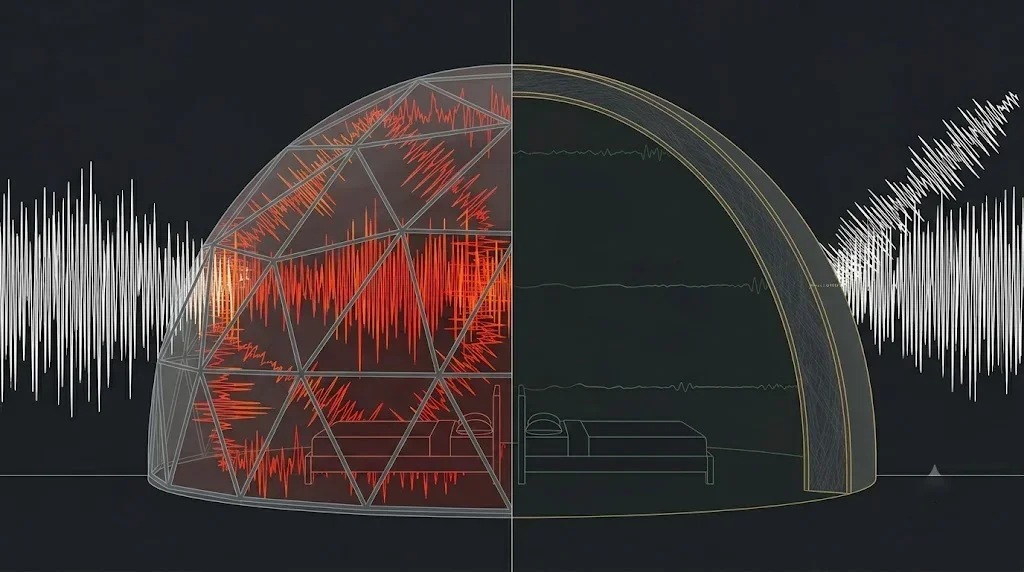
What the guest hears is not the soft patter of rain on a roof. It is a drum solo. Every raindrop strikes the PVC membrane and transmits directly inside — unfiltered, unabsorbed, unimpeded.
The wind picks up. The membrane flutters. The sound is no longer rain. It is a low-frequency roar that penetrates pillows, earplugs, and patience.
The guest leaves a 2-star review the next morning: "Beautiful location. Couldn’t sleep." The operator refunds the night. The booking that follows cancels after reading the review.
The Acoustic Mass Law states that sound transmission loss through a single homogeneous material is determined by its mass per unit area. The empirical principle: every doubling of surface mass adds approximately 6 dB of transmission loss. Halve the mass, lose 6 dB. A material with almost no mass offers almost no resistance to sound.
This is not a complaint about bad weather. It is a complaint about the material the building is made of. And no amount of money — not earplugs, not white noise machines, not acoustic panels — can add mass to a thin membrane.
Why Does a Thin Membrane Amplify Every Sound?
A fabric dome wall is a PVC membrane typically 0.5 mm thick. It weighs roughly 0.6 kg per square meter. In acoustic terms, this is nearly transparent.
Sound travels as a pressure wave. When that wave hits a wall, three things happen: some energy reflects, some is absorbed, and some transmits through to the other side. The heavier the wall, the more energy it takes to set it in motion — and the less sound reaches the interior. This is the Mass Law, and it is unforgiving.
The same principle governs composite boat hulls. Naval architects specify laminate weight knowing that every halving of mass surrenders 6 dB of isolation. The structural skin that handles hydrodynamic loads also keeps engine noise out of the cabin. A thin membrane has no such dual function.
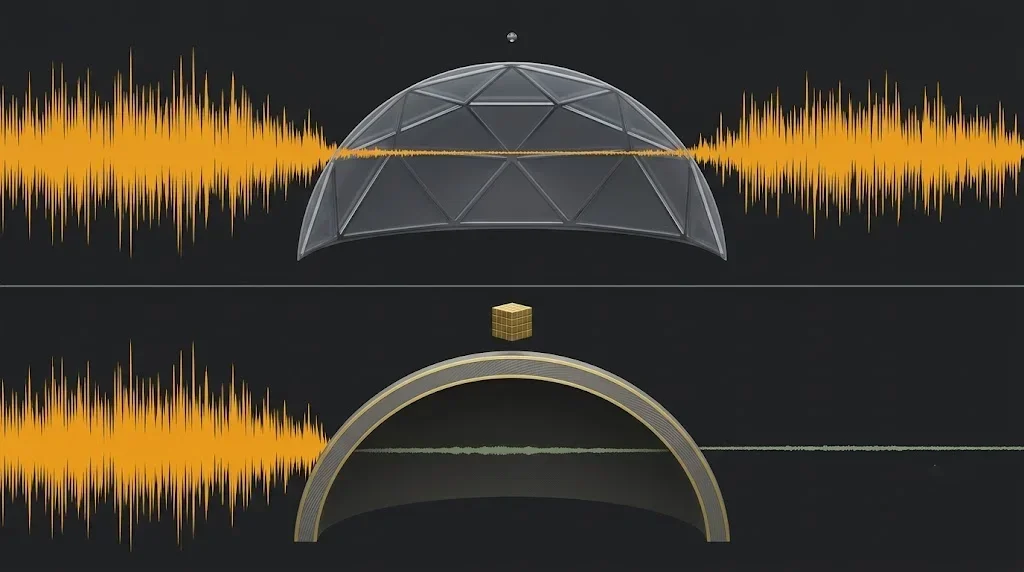
A 0.5 mm PVC membrane provides roughly 5 to 10 dB of sound reduction. For comparison: a typical interior drywall partition provides 30 to 35 dB. A concrete wall provides 50 dB or more.
A fabric dome wall is not a wall in the acoustic sense. It is a loudspeaker cone waiting for a signal.
The membrane does not just fail to stop sound. It actively generates it. Wind makes the surface flutter, creating low-frequency noise that fills the interior.
Rain impact turns the entire dome into a drum head — a large, tensioned surface with an air cavity behind it. The geometry that makes a dome aerodynamic is the same geometry that makes it an efficient sound radiator.
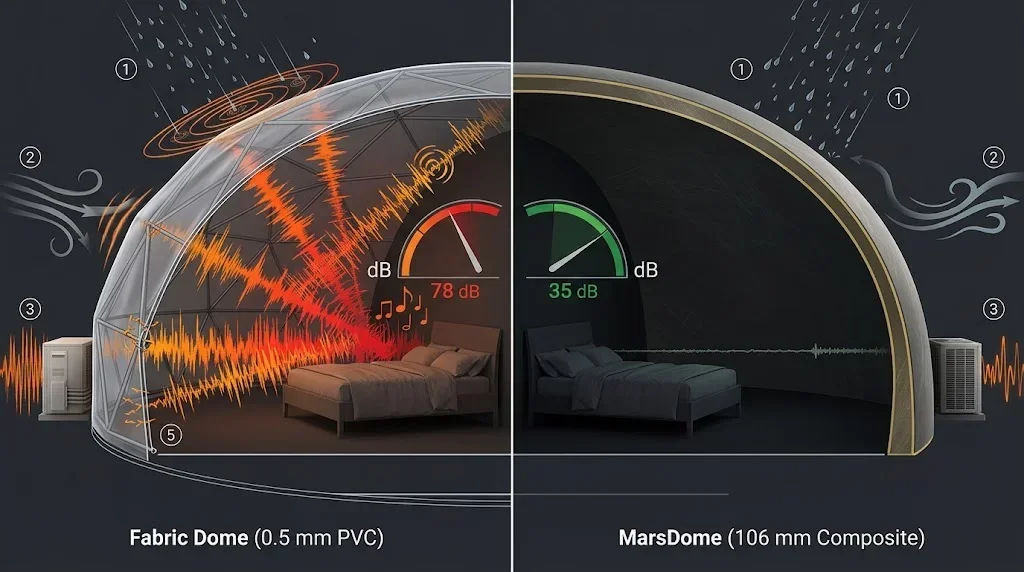
And this is only the beginning. Noise in a fabric dome arrives through five distinct paths, and weather is just one of them.
The Five Layers of Noise No Operator Can Escape
First: weather — rain impact, wind flutter, hail. The membrane transmits them all directly.
This is the noise every operator expects and none can prevent.
Second: HVAC. A fabric dome has negligible insulation — R-1 to R-2. The heater or air conditioner must run constantly to maintain temperature. Every cycle generates mechanical noise.
In a well-insulated building, the HVAC cycles on and off. In a fabric dome, it runs near-continuously. Guests trade one noise source for another.
Third: neighbors. Two fabric domes 10 meters apart share roughly 5 to 10 dB of acoustic separation. A conversation at normal speaking volume is 60 dB. Music at moderate volume is 70 dB.
Through a fabric wall, the neighbor’s evening becomes your guest’s insomnia.
Privacy is not about what you can see. It is about what you can hear.
Fourth: nature — birds at dawn, waves on a shoreline, wind through trees. These are sounds guests want, but on their terms, when they choose to open a door or window.
A fabric wall offers no choice. It admits everything, always. The guest who wanted to sleep until 8am is up at 5:30 with the birds.
Fifth: structure-borne noise. A conventional frame-and-skin dome contains more than 250 bolted connections. Under wind load, thermal expansion, and daily temperature cycling, metal struts and hubs shift against each other.
Creaks, ticks, pops. These sounds travel through the metal frame directly into the interior — structure-borne transmission that bypasses the membrane entirely.
The building itself is the noise source.
What Do Operators Spend Trying to Buy Silence?
Every noise problem has a market of solutions. None of them solve the root cause.
Earplugs cost $0.50 per pair. Some guests use them; others don’t — and the ones who don’t leave reviews. Those who do discover that foam earplugs work best at high frequencies. The rumble of wind flutter and the drum of rain, however, sit squarely in the low end where foam is least effective.
White noise machines: $30 to $80 per unit. They add sound to mask sound, raising the ambient noise floor so that transient events — a gust, a raindrop burst — are less noticeable. They work until the storm gets loud enough that the white noise itself becomes part of the problem. And they require power, which means they fail exactly when off-grid guests need them most.
Acoustic panels: $2 to $5 per square foot, professionally installed. These absorb sound inside the room, reducing echo and reverberation. They do nothing to stop sound transmission through the wall.
Adding acoustic panels to a fabric dome is like hanging curtains in front of an open window and expecting the room to stay warm. Absorption is not isolation.
Then there are the costs that do not appear on any invoice. The refund for the sleepless night. The 2-star review that drops the listing from page one to page three.
The repeat guest who books a hotel next time: "the dome was beautiful but I just couldn’t sleep." Across glamping review platforms, noise trails only temperature as a complaint. And unlike temperature, it cannot be solved with a bigger heater or a second air conditioner.
All of these solutions share one property: they treat the symptom after the sound has already entered the room. None of them can add the one thing that actually stops sound: mass.

What Happens When the Wall Itself Stops the Sound?
A MarsDome shell is 106 mm (4-inch) of solid composite. It weighs approximately 10 to 12 kg per square meter — roughly 18 times the mass of a PVC membrane. Under the Mass Law, every doubling of mass adds 6 dB of transmission loss. Eighteen times the mass is approximately four doublings: 24 dB of additional sound reduction from mass alone.
But mass is only part of the story. The structure itself eliminates three of the five noise layers at the source.
There is no membrane to flutter. A 106 mm rigid composite shell does not move under wind pressure. The aerodynamic surface that sheds wind load is the same surface that blocks sound. There is no separate skin to vibrate, no cavity to resonate, no drum.
There is no frame to transmit structure-borne noise. A MarsDome uses 43 bolts, all embedded within the composite shell — never exposed, never shifting, never creaking under thermal load.
Compare this to the 250-plus exposed bolts in a frame-and-skin structure. Each bolted hub is a potential noise source. Each strut is a transmission path.
A composite sandwich shell has no independent structural members to rub, shift, or click against each other.
There is no HVAC treadmill. At R-28, the composite shell is an R-28 thermal barrier with zero thermal bridges. The HVAC system cycles on and off like a normal building, not continuously like a fabric dome fighting ambient air.
Less runtime means less mechanical noise. And the shell’s thermal mass holds temperature for hours even if the system is off — no urgent cycling, no overnight noise spikes.
The same 106 mm that insulates is the 106 mm that silences. There is no separate acoustic treatment, no added liner, no aftermarket solution. The structural material IS the acoustic solution.
This is not an upgrade. It is a different material category.
How Much Difference Does 106 mm Make to a Sound Wave?
Apply the Mass Law to both structures. Then let the numbers speak.
PVC membrane at 0.6 kg/m² produces a predicted transmission loss of approximately 12 dB at 500 Hz — the center of speech and music frequencies. A 90 dB storm outside registers at roughly 78 dB inside. That is a vacuum cleaner at close range, sustained, all night.
MarsDome composite shell at 10 kg/m²: at the same 500 Hz, predicted transmission loss exceeds 38 dB from mass alone. Add the stiffness of a rigid composite shell with no flutter and no structure-borne paths. The measured reduction: ΔR_w_ ≥ 35 dB across the full frequency spectrum. A 90 dB storm outside registers at 35 dB inside — the sound level of a quiet library.
The difference between 78 dB and 35 dB is not incremental. It is the difference between a guest who cannot sleep and a guest who does not know there is a storm. Between a refund request and a 5-star review. Between a structure that creates complaints and a structure that eliminates them.
| Noise Source | Conventional PVC Membrane Structure (0.5 mm PVC) |
MarsDome (106 mm Composite) |
|---|---|---|
| Rain impact | Drum effect — 70–80 dB interior. Every drop transmits directly through the membrane. | Negligible. Rigid shell does not vibrate under raindrop impact. Rain is inaudible inside. |
| Wind flutter | Low-frequency membrane flutter — 60–75 dB. Entire surface acts as a loudspeaker. | None. Composite shell is rigid. No membrane to flutter. |
| HVAC cycling | Near-continuous operation due to R-1–R-2 insulation. Mechanical noise throughout the night. | Normal cycling at R-28. Thermal mass buffers temperature, reducing runtime and noise. |
| Neighbor noise | 5–10 dB isolation between units. Conversations and music transmit clearly. | ΔRw ≥ 35 dB isolation. Adjacent units are acoustically independent. |
| Structure-borne | 250+ bolted connections shift and creak under thermal and wind load. | 43 embedded bolts. Zero independent structural members. No structure-borne noise path. |
| Storm total (90 dB outside) | ~78 dB inside — vacuum cleaner level. Guest cannot sleep. | ~35 dB inside — library level. Guest does not know there is a storm. |
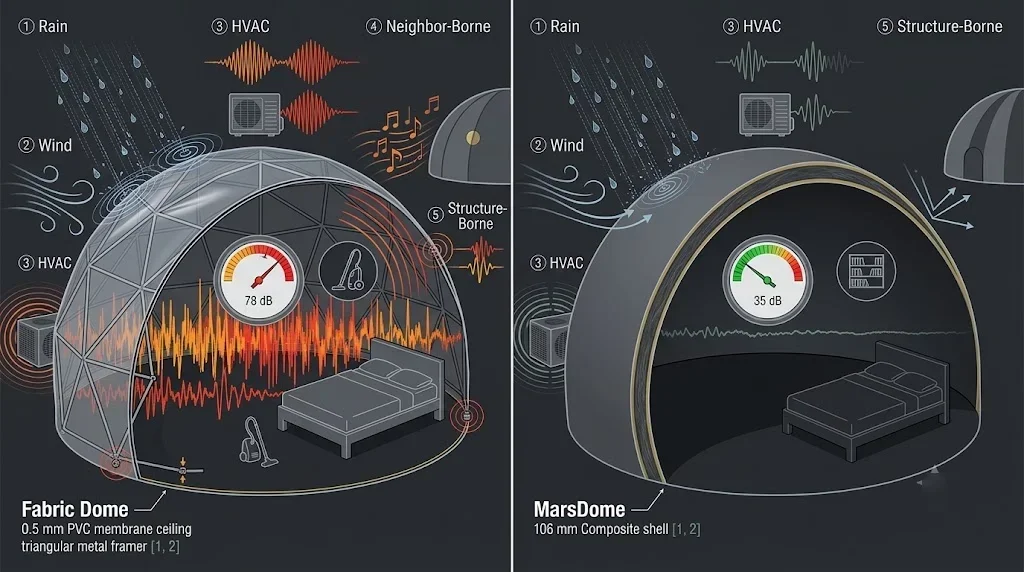
The numbers are not complicated. A thin membrane cannot stop sound because it has almost no mass. A thick composite shell stops sound because mass is the only thing that does.
Every other solution — earplugs, white noise, acoustic panels — operates downstream of the failure. The failure is the wall itself.
This is why noise is the one problem money cannot fix in a fabric dome. Condensation can be managed with dehumidifiers. Temperature can be fought with bigger HVAC systems. Wear and tear can be addressed with replacement covers and maintenance schedules.
Each of these costs money, but each has a solution that money can buy within the existing architecture.
Noise does not. The only thing that stops sound is mass, and the only way to add mass is to change the material the building is made of.
That is not an expense. It is a design decision. And for the fabric dome operator, it is a decision that has already been made — by the structure they bought.
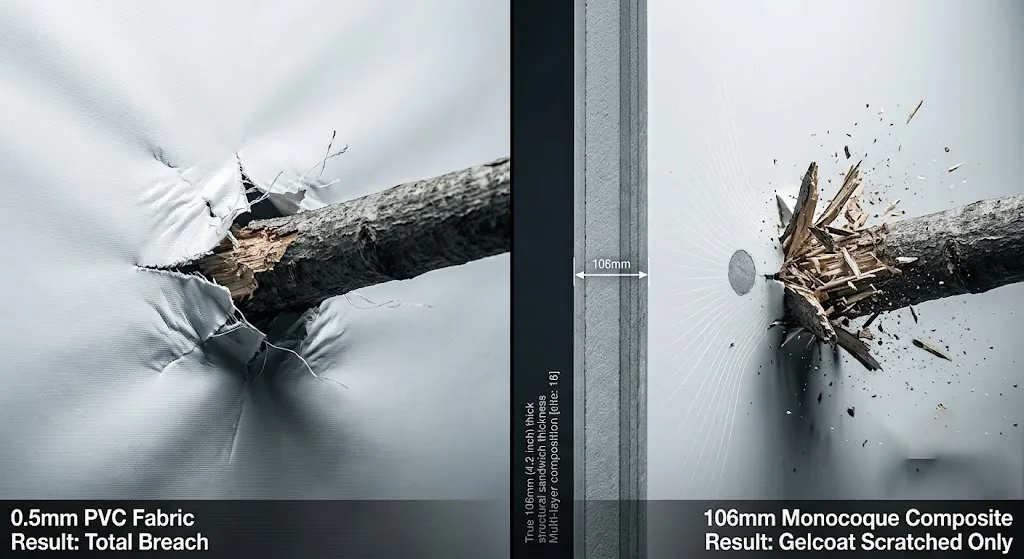
Continue reading: How the same 106 mm composite shell handles wind-borne debris in Wind Picked the Dome. Physics Picked the Composite.
Why frame-and-skin to composite shell is a structural category change, not an upgrade: From Fabric to MarsDome: Not an Upgrade, a Structural Category Change.