
The 3am drip
A guest wakes up to water on their pillow. The operator gets the call. By morning, a maintenance crew is on a ladder, inspecting seam tape, checking tension, hunting for the hole.
They find one patch. Another opens the following week. A different panel the week after. The leaks migrate. The operator starts budgeting for monthly inspections. The guest reviews mention "glamping, but wet."
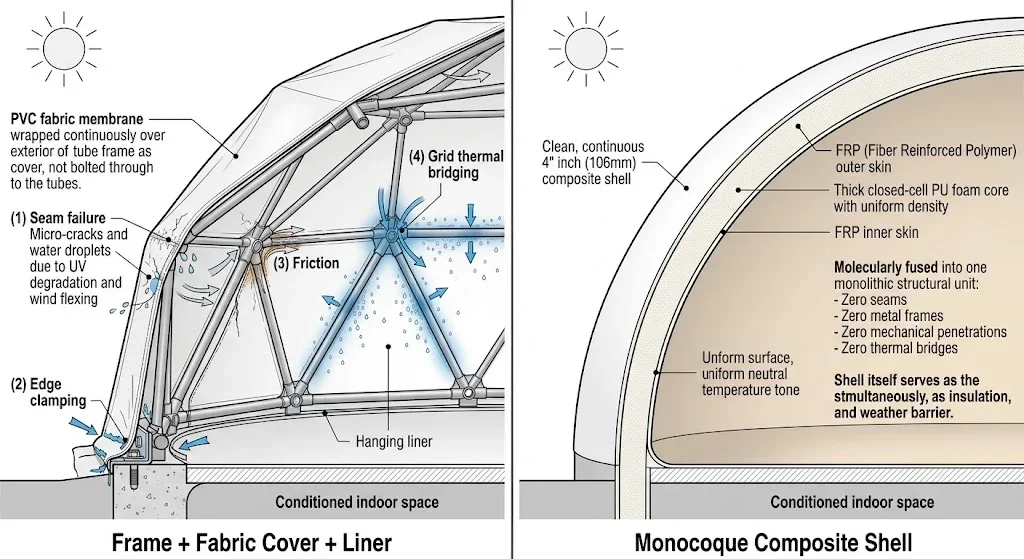
Frame-skin separation is the design approach where a steel tube frame provides structural support and a PVC fabric cover provides weatherproofing — two independent systems, one draped over the other. The cover is assembled from dozens of triangular panels welded together at seams. Those seams degrade under UV and wind flex. At the base edge and around openings, metal clamping strips bolt through the fabric into the foundation: the penetrations are few but consequential. And wherever steel tubes press against the inside of the fabric, condensation forms — a cold bridge that drips. This is not a manufacturing defect. It is the consequence of depending on welded seams, clamped edges, and a steel skeleton to keep weather out.This story repeats at fabric dome sites across climates — desert, tropics, mountains. It's not bad maintenance. It's not a bad brand. It's a design decision made at the very beginning: separate the structure from the skin.
How a fabric dome frame creates leak points
A geodesic dome built with a metal frame and fabric cover has three categories of potential water entry:
- Welded seam failure. The cover is not one piece. It's dozens of triangular PVC panels joined by welded or taped seams. UV breaks down the weld chemistry. Wind flex cycles pull panels apart at the seam line. Temperature swings expand and contract the material along every seam. A seam that held last season doesn't hold this one.
- Seam lines between fabric panels. Taped or welded. Tape ages. UV breaks it down. Temperature cycles from −20°C to +40°C loosen every bond. Wind flexes the fabric and pulls at every seam.
- Node-to-skin contact points. Wherever the metal frame touches the inside of the skin, it's a thermal bridge. In cold weather, condensation forms on the inside at these points. It drips. It looks like a leak. To a guest with a wet pillow, the distinction doesn't matter.
Add them up. Dozens of seam joints accumulating UV damage. Clamping penetrations at the base edge. Friction-wear points where fabric rubs steel. The water does not need hundreds of bolt holes through the skin. It needs one cracked seam and a worn contact point. That is enough.
Condensation: the leak that isn't a leak
Inside the dome: 22°C. Outside: −5°C.
The metal frame conducts heat out at every node. Wherever the frame contacts the skin, the interior surface temperature drops below the dew point. Condensation forms — water dripping from the *inside* of the dome. Not a roof leak, but indistinguishable from one at 3am.
The operator adds ventilation. Runs a dehumidifier. Upgrades the HVAC. These work — marginally, expensively. But they're not fixing the mechanism. They're fighting the frame.
What to do if you already operate fabric domes
If your site runs on fabric domes today:
- Budget for leak inspection and repair. This is a maintenance line item, not a surprise. Monthly during rainy or freeze-thaw seasons.
- Have a middle-of-the-night protocol. Guest calls about water don't wait for morning. Your night manager needs a procedure: move guest, document, inspect at first light.
- Know which panels fail first. Track patterns. South-facing panels UV-degrade faster. Windward panels flex more. Map your failures — you'll see the hotspots.
- The problem isn't you. It's not your team. It's not your maintenance practices. It's inherent to depending on welded seams, clamped edges, and a steel frame that bridges cold straight to the interior.
What to ask before buying your first dome
- How are the seams constructed, and what is their field life expectancy? Not lab data. Ask how many linear meters of welded seam protect this structure from weather. Ask for operator references who have been through three or more seasonal cycles in a climate like yours.
- How are thermal bridges mitigated at nodes? "Ventilation" and "dehumidifier" are not mitigation strategies. They're compensating.
- What is the seam life expectancy in the field? Not lab data. Not "waterproof rating." Actual field data from sites in a climate like yours.
- Talk to operators running these domes for 3+ years. Not the new installs. The ones who've been through seasons. Ask about water.
The industry has tried everything
Heavier deniers. PTFE membranes. Double-layer skins. Tension systems. Custom seam tapes. Each iteration reduces leaks marginally. None eliminates them.
The improvement curve is incremental. The underlying problem is categorical: any system where water-tightness depends on welded seams in a UV-exposed flexible skin, clamped edges, and a steel frame that creates condensation, will leak eventually.
You can move the timeline. You can't remove the mechanism.
One shell. Zero attachment points. Zero seams.
The alternative isn't "a better fabric dome." It's a structure with no fabric and no frame.
A structural composite shell. The shell carries the load. The shell provides the insulation. The shell keeps water out. Nine rigid panels interlock into one shell, engineered like a boat hull — not a tent with a metal skeleton.
Nine composite panels interlock to form the dome. No fabric. No frame. No seam tape. No welded seams. No clamped edges. No contact wear. No condensation grid.
The water entry point count? Zero.*See the cross-section, the installation, and the full specification: View the MarsDome engineering summary →*